
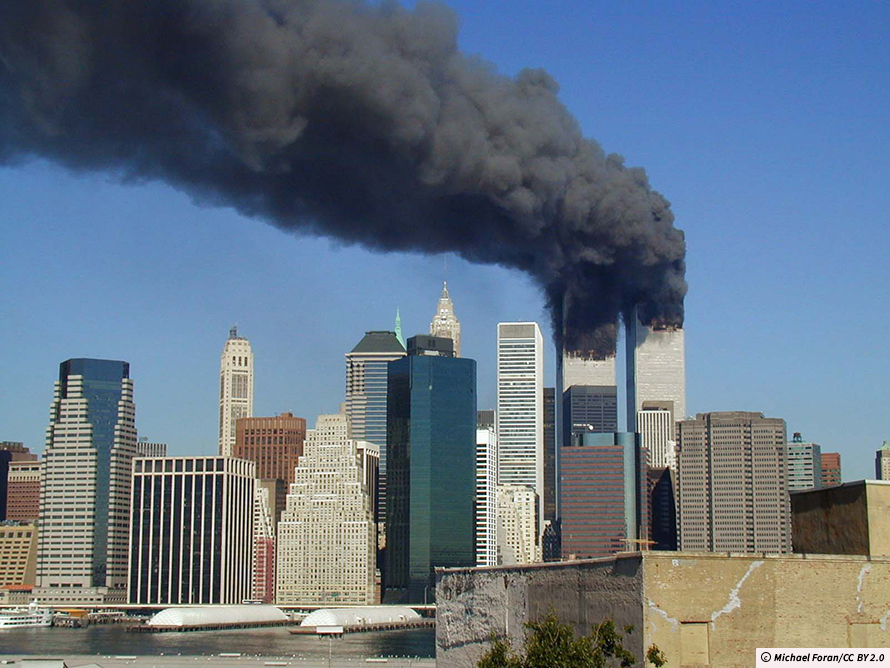
Can we tackle online conspiracies? Twenty-five years after the deadliest terror attack in history, disinformation about the event is everywhere. Some say it is time to fight back.
It is often said that we live in a post-9/11A series of terrorist attacks that took place in the USA on 11 September 2001. It is known as 9/11 as Americans write the month first, and then the date. The attacks killed 2,996 people. Many of them died when two planes were hijacked and hit the twin towers of the World Trade Center in New York, causing them to collapse. world. Few events have done more to define the times in which we live.
On 11 September, 2001, a group of Islamist terrorists hijacked four planes, flew two of them into the World Trade Center in New York and a third into the PentagonThe headquarters of the US Defence Department, so-called because it has five sides. In 1967, peace protestors attempted unsuccessfully to levitate it (making it rise into the air) until all evil emissions had fled, in the hope of ending the Vietnam War.. The last one crashed after the passengers heroically took on the hijackers. They killed almost 3,000 people.
Just a decade before, the USSRThe United Socialist Soviet Republic, the USA’s main rival in the Cold War before it collapsed and broke up into a number of smaller states in 1991. had collapsed. The Cold WarA period of diplomatic conflict between blocs led by the USA and the USSR that lasted from 1947 until 1991, when the USSR collapsed. was over. Experts predicted a new age of global peace and prosperityHaving lots of wealth and success.. Then, suddenly, one September morning, a new era of terror and conflict arrived.
So it should perhaps not be surprising that such a traumatic event has also given rise to a number of conspiracy theoriesTheories that explain world events by blaming shady groups of powerful people operating in secret. Some conspiracy theories have a basis in fact, but many more of them are completely invented. What is more, they often play on dangerous prejudices such as antisemitism. It’s worth being especially cautious and critical when you come across accounts that ascribe enormous agency to small and secretive groups..
These began shortly after the attacks, when a small number of analystsExperts who look closely at data or trends (like school results or the economy) to explain what is happening and predict what might happen in the future. claimed that plane collisions would not have not caused the collapse of the towers of the World Trade Center.
They said the fires caused by the collisions would not have been hot enough to melt the steel framework of the towers. Instead, they argued, the US government deliberately destroyed them in a false flagA harmful action designed on purpose so it will look like someone else is responsible. attack.
This is not true. The collisions caused massive damage to the towers’ support columns, and the fires that they caused reached as much as 1,000C – enough to warp the steel beams within and ultimately cause the structures to collapse entirely.1
Many 9/11 conspiracies are antisemiticHostile to or prejudiced against Jewish people. . Online extremists falsely claim JewishRelating or belonging to the religion of Judaism. employees in the World Trade Center did not show up to work on 11 September because they had received advance warning of the attack. In reality, hundreds of Jewish people died that day alongside their fellow New Yorkers.2
When these 9/11 conspiracies began, the internet was still in its infancy. Since then, the explosion of social media has spread them much further.
By 2020, 20% of Americans believed their own government played a part in the 9/11 attacks.3
This is why some think we need stronger measures against online conspiracy theories. They say journalists must do much more to ensure they are putting out truthful coverage on online platforms, so that the conspiracy theorists do not have free rein.
Research has found that rather than offering “balance” or gently pushing back on conspiracy theorists, the most effective way of suppressing disinformationFalse information intended to mislead, including propaganda, which all too often encourages the spread of misinformation, fake news spread by mistake. It is contrasted with misinformation, which may be spread accidentally. is for media outlets either to tackle them head-on – the “debunking” approach – or not to talk about them at all.4
Another option is to incorporate advice on spotting false stories into the education system, to “vaccinate” people against disinformation.
But others say the problem goes deeper than this. After all, 9/11 conspiracy theories might spread more easily online, but they came into being long before social media.
The issue, they argue, is that the world has become a deeply confusing and frightening place.
After 9/11, the US launched wars in the Middle East for reasons few Americans understood. They seemed to go on forever without achieving anything. Meanwhile, the terrorism threat did not go away; if anything, it seemed to intensify.
When it seems as if the government is not being honest about one thing, it can become natural to assume it is lying about everything. That is when conspiracy theories thrive.
So rather than online fact-checks or education, many think the only way to end the conspiracy theories is for governments to be much more open, to restore their citizens’ trust.
Can we tackle online conspiracies?
Keywords
9/11 – A series of terrorist attacks that took place in the USA on 11 September 2001. It is known as 9/11 as Americans write the month first, and then the date. The attacks killed 2,996 people. Many of them died when two planes were hijacked and hit the twin towers of the World Trade Center in New York, causing them to collapse.
Pentagon – The headquarters of the US Defence Department, so-called because it has five sides. In 1967, peace protestors attempted unsuccessfully to levitate it (making it rise into the air) until all evil emissions had fled, in the hope of ending the Vietnam War.
USSR – The United Socialist Soviet Republic, the USA’s main rival in the Cold War before it collapsed and broke up into a number of smaller states in 1991.
Cold War – A period of diplomatic conflict between blocs led by the USA and the USSR that lasted from 1947 until 1991, when the USSR collapsed.
Prosperity – Having lots of wealth and success.
Conspiracy theories – Theories that explain world events by blaming shady groups of powerful people operating in secret. Some conspiracy theories have a basis in fact, but many more of them are completely invented. What is more, they often play on dangerous prejudices such as antisemitism. It’s worth being especially cautious and critical when you come across accounts that ascribe enormous agency to small and secretive groups.
Analysts – Experts who look closely at data or trends (like school results or the economy) to explain what is happening and predict what might happen in the future.
False flag – A harmful action designed on purpose so it will look like someone else is responsible.
Antisemitic – Hostile to or prejudiced against Jewish people.
Jewish – Relating or belonging to the religion of Judaism.
Disinformation – False information intended to mislead, including propaganda, which all too often encourages the spread of misinformation, fake news spread by mistake. It is contrasted with misinformation, which may be spread accidentally.

- As described by The Conversation, a website that makes academic research accessible to a general audience.
- According to the BBC.
- According to a survey conducted by the pollster YouGov.
- According to a study carried out by researchers in the city of Bern in Switzerland.




pendle vale college - 8G
conspiracy theories allow us to discuss other possibilities but we should be careful what we believe and read.
The Coopers Company and Coborn School - 9.7
We think there are too many conspiracies to effectively tackle- more will arise while others are debunked. Unless people can trust the news to be objective, they will believe unqualified people online.
Deutsche Internationale.Schule Johannesburg - 7
Put down the phones 😃
British school of malaga - year 8
I dont think we can stop the conspiracies since its just people wanting to get popular and seeking attention, but I do think we can stop some conspiracies by removing them
Munich International School - 8F
I do not think that we can. I just think that there are too many people like that seeking attention out there, and we can’t stop them, I think we should rather educate more like you are doing it.