
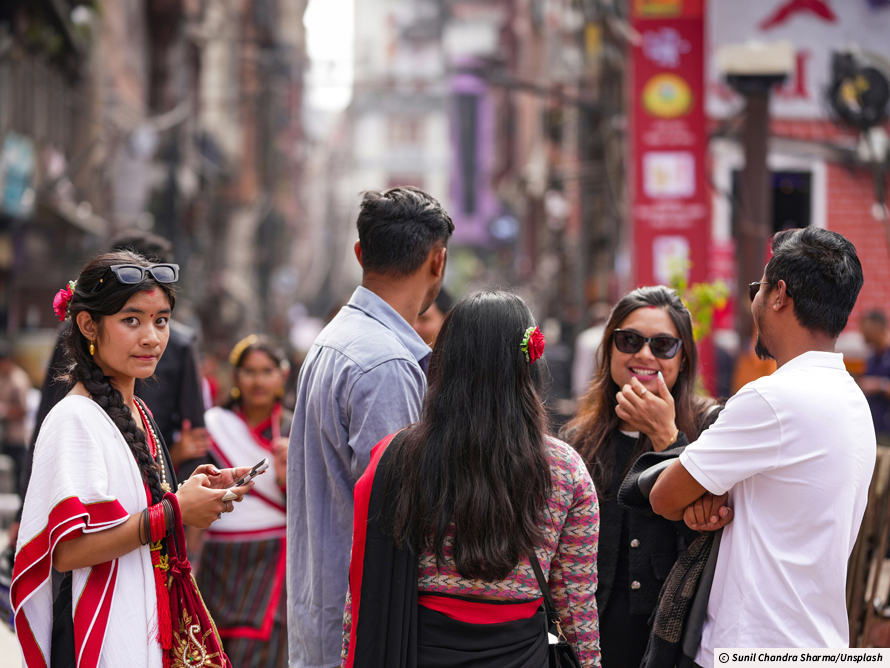
For many, many young Nepali people, a lack of opportunities at home means that migration feels like their only option. But, like Divyanshu Khanal, 15, from Pathways School Noida, they do so with a heavy heart.
I was born in Nepal, but my story starts outside it and that is exactly the problem with the country I call home.
Migration is often described as opportunity, a sign of global mobility, ambition, globalisation, even progress. But what happens when it starts becoming an expectation?
Every day 1,700 Nepalis fly abroad even during wars such as those going on between Russia and Ukraine, and the US war with Iran.1
This movement is not based on ambition alone but by a system that makes staying a harder choice.
Some might argue that Nepalis leave because globalisation offers better opportunities abroad, but that very argument exposes how the system fails us back home.
The country that boasts the peaks of some of the world’s tallest mountains also peaks in the list of countries with the highest rates of remittances — money received from relatives working outside the country – by the share of GDP.2
Remittances outweigh Nepal’s industrial output, hiding true growth. The country’s ability to sustainably industrialise is determined by a lack of industries.
Industries only contribute 12.8% of the total GDP (2024), a level far below the global average of 26%. Various initiatives have failed owing to, among other things, recent political uncertainty.
This failure is not just confined to reports, but spreads into people’s lives: silent decisions made for entire generations. If opportunity cannot be built at home, then home itself must be created elsewhere.
Recent political upheavals and a revolving door of leadership seem only to have sharpened this national frustration, turning what should be a time of democratic evolution into a catalyst for further departure.
Houses are built but many remain empty. Or they are filled with money but emptied of presence; family becomes just a scheduled call, a notification and a face on a screen.
Traditions do not disappear overnight; rather they fade slowly into pictures and videos; memories revisited rather than lived experiences. They shift from being something we are to something we are constantly trying not to forget.
Yet in leaving, Nepali culture travels too, carried by those forced to make a home elsewhere.
This is where frustration forms into something sharper.
I am part of this story. I live outside Nepal, benefitting from the systems I know are failing it. I carry the very opportunities my country could not give me and with that there exists a quiet guilt.
It is strange to succeed as a result of failure. To know that the reason you are able to dream freely is because of something home could not give you.
And I am not alone in this contradiction. In a country where youth employment stands at 20%, one of the highest in the region, thousands continue to leave every single day; generally not because they want to, but because staying is risking a dream they cannot live if they remain.
I am both a witness and participant. I critique the system, yet I exist outside it. I speak to reform, yet my own opportunities were shaped by its failure. I am not separate from the story, I am evidence of it.
The dilemma remains: loyalty to home, or loyalty to my own becoming.
What would you choose?
Interested in submitting your own Student Voices article or video and automatically entering our Student Young Journalist of the Year Awards? Find out more here.
References
