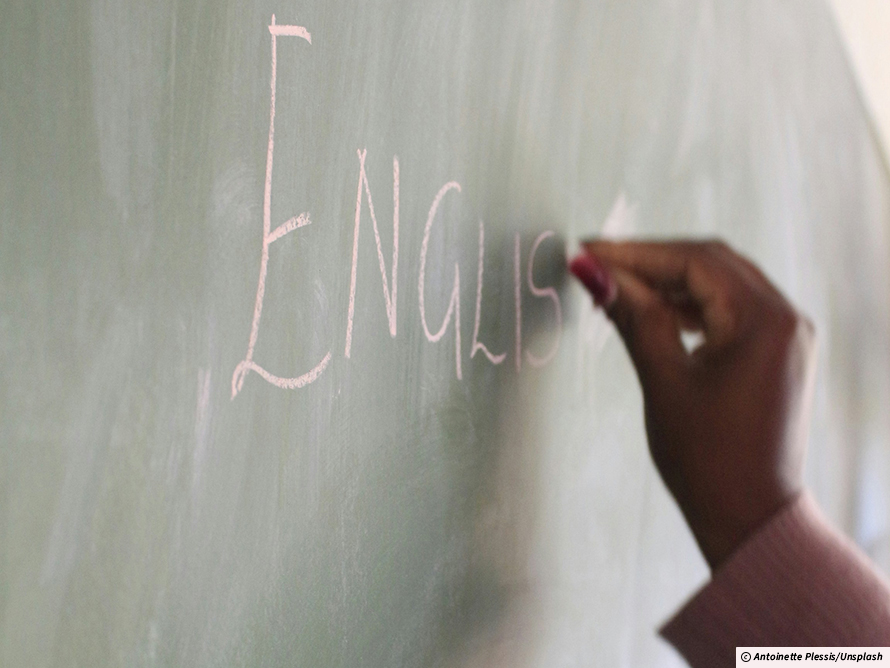
The English language stands in a place of real danger and could be subject to “reverse evolution”, Linnea Cecile Skille, 16, from Chatsworth International School, Singapore
Grammar books and dictionaries are gathering dust in the bookshelves of Gen Z.
A frightening number of young adults do not know the difference between “you’re” and “your”; “they’re”, “their” and “there”. And the word “whom” is disappearing from the modern English lexicon.
But perhaps what is worse than the slowly dissipating rules of language: Gen Z claims that “it’s not that deep”.
Social media has seen a decline in literacy rates over the past few years. Comment sections on TikTok, Instagram, and X reveal arguments over misspelled captions. Many argue that the grammar police are overreacting and being dramatic, that your in place of you’re is not the end of the world. Others argue that it is, in fact, “very deep”.
It is no secret that literacy rates have been falling in recent years. From 2017 to 2023, the recorded percentage of 16-24-year-olds who read at the lowest literacy rate in the USA increased from 16% to 25%. An OECD (Organisation for Economic Co-operation and Development) survey in 2024 found that the general literacy skills of adults in 31 countries were decreasing, except for in the top 10% of countries.
The skill inequality across countries is getting worse due to the lack of care for proper linguistic education.
Unfortunately, falling literacy rates are not being taken seriously. Many have misunderstood the definition of literacy rates and believe it refers to being able to read and write at a basic level, when in reality it refers to a person’s ability to read, write, speak and listen in a way that lets us effectively communicate with the world.
Declining literacy rates might seem insignificant when compared with other global issues, especially at the moment. Countless people believe that it is a waste of time to occupy oneself with a problem such as this. Social media sees this in comment sections all across the board: “you can still understand it, so what does it matter?” So many fail to see the very real threat such illiteracy poses.
When commas, semicolons, and periods (full stops) are no longer used, like in the older times of English, it will become difficult to understand others and to make oneself understood. This has happened to many indigenous languages before: their structures become less emphasised when they are taught, and the grasp of the language deteriorates. Of course, it is not fair to compare a global language like English to less-spoken languages, but it is facing the same real consequences.
If we are not careful and fail to pay attention to grammar, English stands in a place of real danger of reverse evolution. Academic writing and classic literature could be lost because of an ignorance spurred on by indifference and far too much tolerance towards poor grammar skills.
Shakespeare’s work could become admired for its complexity of English rather than its themes and storybuilding. Who is to teach our children English in the future if we cannot even understand it?
Interested in submitting your own Student Voices article or video and automatically entering our Student Young Journalist of the Year Awards? Find out more here.
References:
References
OECD. “Adult Skills in Literacy and Numeracy Declining or Stagnating in Most OECD Countries.” OECD, 10 Dec. 2024,
Harkay, Jessika. “Many Young Adults Barely Literate, yet Earned a High School Diploma.” The 74, 16 Oct. 2025. Accessed 27 Apr. 2026.
National Literacy Trust. “What Is Literacy?” National Literacy Trust, 2017. Accessed 27 Apr. 2026.
