Can we tackle online conspiracies? Twenty-five years after the deadliest terror attack in history, disinformation about the event is everywhere. Some say it is time to fight back.
Wild theories distort 9/11 memories
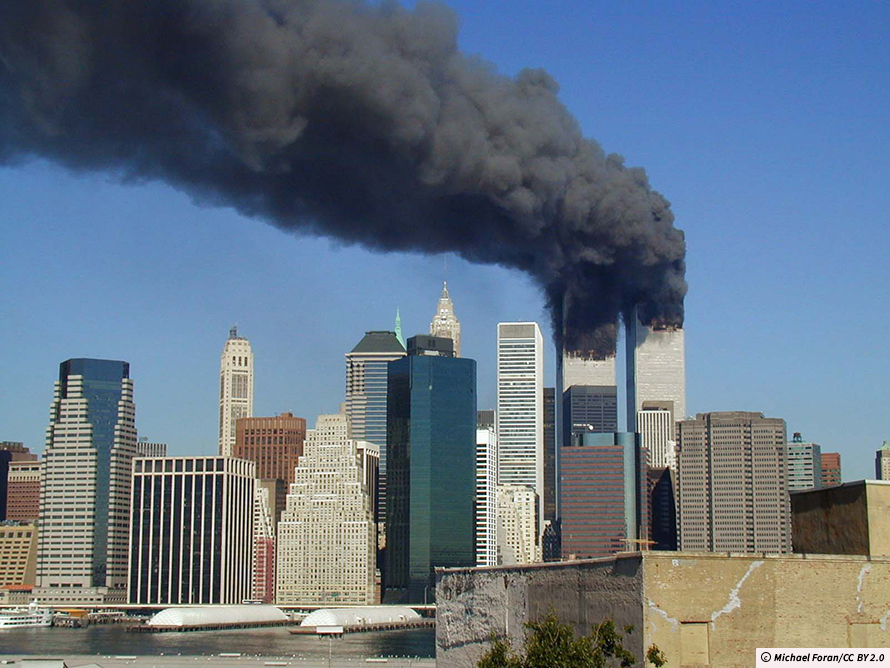 Targetted terror: Twenty-five years after the world's deadliest terror attack, the enduring legacy of 9/11 faces a rising tide of online disinformation.
 Glossary
9/11 - A series of terrorist attacks that took place in the USA on 11 September 2001. It is known as 9/11 as Americans write the month first, and then the date. The attacks killed 2,996 people. Many of them died when two planes were hijacked and hit the twin towers of the World Trade Center in New York, causing them to collapse.
Pentagon - The headquarters of the US Defence Department, so-called because it has five sides. In 1967, peace protestors attempted unsuccessfully to levitate it (making it rise into the air) until all evil emissions had fled, in the hope of ending the Vietnam War.
USSR - The United Socialist Soviet Republic, the USA’s main rival in the Cold War before it collapsed and broke up into a number of smaller states in 1991.
Cold War - A period of diplomatic conflict between blocs led by the USA and the USSR that lasted from 1947 until 1991, when the USSR collapsed.
Prosperity - Having lots of wealth and success.
Conspiracy theories - Theories that explain world events by blaming shady groups of powerful people operating in secret. Some conspiracy theories have a basis in fact, but many more of them are completely invented. What is more, they often play on dangerous prejudices such as antisemitism. It's worth being especially cautious and critical when you come across accounts that ascribe enormous agency to small and secretive groups.
Analysts - Experts who look closely at data or trends (like school results or the economy) to explain what is happening and predict what might happen in the future.
False flag - A harmful action designed on purpose so it will look like someone else is responsible.
Antisemitic - Hostile to or prejudiced against Jewish people.
Jewish - Relating or belonging to the religion of Judaism.
Disinformation - False information intended to mislead, including propaganda, which all too often encourages the spread of misinformation, fake news spread by mistake. It is contrasted with misinformation, which may be spread accidentally.