But is physics the best science? With funding cuts, collapsing universities and a teacher shortage, Britain’s physicists worry about the future of their once-celebrated subject.
British physics facing a ‘catastrophe’
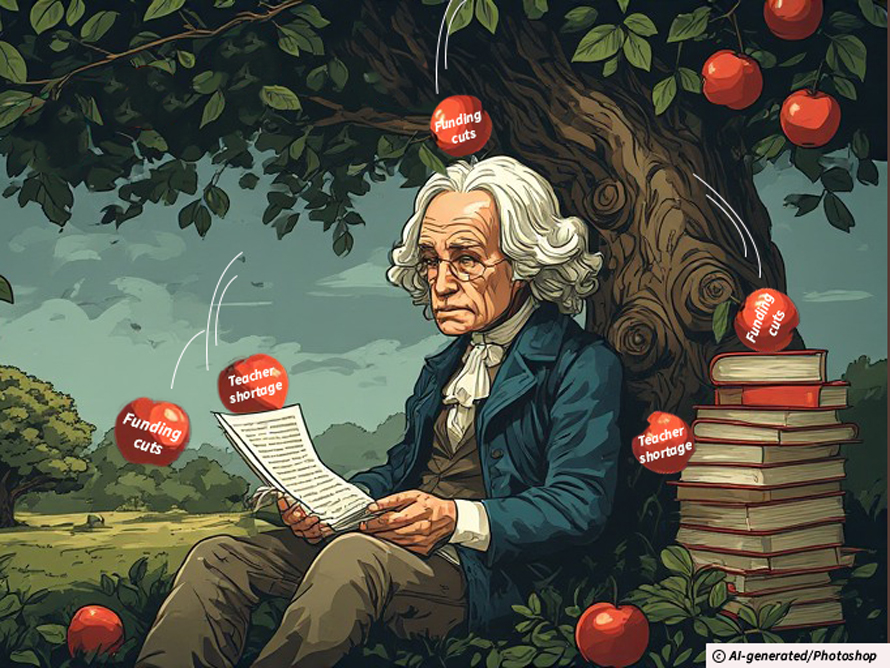 Apple a day: If Isaac Newton had lived today, would he have had the education and funding to become a successful physicist?
 Glossary
Isaac Newton - A central figure of the Scientific Revolution (1642-1726). His influence was huge, but he is most remembered for coming up with the theory of gravity when an apple fell on his head.
Gravity - An invisible force that pulls objects towards each other. Earth's gravity keeps us on the ground and makes things fall. It is less strong on Mars.
Higgs boson - The subatomic particle was first theorised in the 1960s, but observed in the LHC in 2012. Its existence does not challenge the Standard Model of particle physics.
Particle physics - The study of subatomic particles, and the structure and forces that affect them.
Astronomy - The study of everything beyond the Earth's atmosphere.
Triple science - A GCSE option where students can study Biology, Chemistry and Physics as distinct subjects and gain three GCSEs, rather than two Combined Science GCSEs. Many schools only offer triple science GCSE to the students they consider most able. Students who take triple science at GCSE are more likely to study sciences at A-level.
GCSE - The national exams taken by 15 and 16-year-olds in parts of the UK.
Galaxies - A system of gas and dust and billions of stars, held together by gravity.
Matter - In physics, any substance that possesses mass and occupies space. Matter is made of molecules or atoms.